Tuesday, March 5, 2013

Sunday, March 3, 2013
STEVEN SASSON DIGITAL CAMERA INVENTOR
Time for some history. Steven J. Sasson is an American electrical engineer and the inventor of the digital camera in 1975. This first digital camera above recorded a black-and-white image on a digital cassette tape! Commodore modified the cassette tape recorder as well and called it the Datasette. Commodore sold them under the model designations C2N or VIC 1530, designed for use with the VIC-20, C64 and PET and CBM 2000/3000/4000/8000/9000 models.
OK, back to the camera … this 8-pound monster captured the black-and-white image at a resolution of .01 megapixels, took 23 seconds to record onto a digital cassette tape and another 23 seconds to read off a playback unit onto a television. Then it popped up on the screen, yeah!
“You could see the silhouette of her hair,” Sasson said. But her face was a blur of static. She was less than happy with the photograph and left, saying “You need work,” he said. But Sasson already knew the solution: reversing a set of wires, the assistant’s face was restored.
Sasson still works at Eastman Kodak Company and now works to protect the intellectual capital of his employer. Wikipedia writes, “On November 17, 2010, US President Barack Obama awarded Sasson the National Medal of Technology and Innovation at a ceremony in the East Room of the White House. This is the highest honor awarded by the US government to scientists, engineers, and inventors.”
OK, back to the camera … this 8-pound monster captured the black-and-white image at a resolution of .01 megapixels, took 23 seconds to record onto a digital cassette tape and another 23 seconds to read off a playback unit onto a television. Then it popped up on the screen, yeah!
“You could see the silhouette of her hair,” Sasson said. But her face was a blur of static. She was less than happy with the photograph and left, saying “You need work,” he said. But Sasson already knew the solution: reversing a set of wires, the assistant’s face was restored.
Sasson still works at Eastman Kodak Company and now works to protect the intellectual capital of his employer. Wikipedia writes, “On November 17, 2010, US President Barack Obama awarded Sasson the National Medal of Technology and Innovation at a ceremony in the East Room of the White House. This is the highest honor awarded by the US government to scientists, engineers, and inventors.”
LOUIS DAGUERRE WHO INVENTED FIRST CAMERA
Louis Daguerre (Louis Jacques Mande Daguerre) was born near Paris, France on November 18, 1789. A professional scene painter for the opera with an interest in lighting effects, Daguerre began experimenting with the effects of light upon translucent paintings in the 1820s.
Louis Daguerre regularly used a camera obscura as an aid to painting in perspective, and this led him think about ways to keep the image still. In 1826, he discovered the work of Joseph Niepce, and in 1829 began a partnership with him.
He formed a partnership with Joseph Niepce to improve upon the photography process Niepce had invented. Niepce, who died in 1833, produced the first photographic image, however, Niepce's photographs quickly faded.
After several years of experimentation, Louis Daguerre developed a more convenient and effective method of photography, naming it after himself - the daguerreotype.
According to writer Robert Leggat,"Louis Daguerre made an important discovery by accident. In 1835, he put an exposed plate in his chemical cupboard, and some days later found, to his surprise, that the latent image had developed. Daguerre eventually concluded that this was due to the presence of mercury vapour from a broken thermometer. This important discovery that a latent image could be developed made it possible to reduce the exposure time from some eight hours to thirty minutes.
Louis Daguerre introduced the daguerreotype process to the public on August 19, 1839 at a meeting of the French Academy of Sciences in Paris.
In 1839, Louis Daguerre and Niépce's son sold the rights for the daguerreotype to the French government and published a booklet describing the process.
Saturday, March 2, 2013
Best cinematography Theory
5 C?s of Cinematography ...Mascelli
Cinematography, Theory and Practice ..Blain Brown
The Negative.......Ansel Adams
Film Form: Essays in Film Theory.....Sergei Eisenstein
Practice/Field
The ASC Manual ....ASC (The daddy-o)
The Camera Assistant......Douglas Hart
The Camera Assistant Manual............David Elkins
Cinematographer's Pocket Reference....Blain Brown
Cinematographer's field guide...............Kodak
Lighting
Painting with Light...........John Alton
Matters of Light and Depth...............Ross Lowell
Film Lighting..............Kris Malkiewicz
Motion Picture & Video Lightin........ Blain Brown
Interior Color by Design????????Jonathan Poore
Movement & Blocking
Cinematic Motion..............Steven Katz
Grammar of the Film Language..........Daniel Arijon
Shot by Shot.....................Steven Katz
Gee-whiz-ology(inspiration)
Cinemtography.......................... Peter Ettedgui
5 C?s of Cinematography ...Mascelli
Cinematography, Theory and Practice ..Blain Brown
The Negative.......Ansel Adams
Film Form: Essays in Film Theory.....Sergei Eisenstein
Practice/Field
The ASC Manual ....ASC (The daddy-o)
The Camera Assistant......Douglas Hart
The Camera Assistant Manual............David Elkins
Cinematographer's Pocket Reference....Blain Brown
Cinematographer's field guide...............Kodak
Lighting
Painting with Light...........John Alton
Matters of Light and Depth...............Ross Lowell
Film Lighting..............Kris Malkiewicz
Motion Picture & Video Lightin........ Blain Brown
Interior Color by Design????????Jonathan Poore
Movement & Blocking
Cinematic Motion..............Steven Katz
Grammar of the Film Language..........Daniel Arijon
Shot by Shot.....................Steven Katz
Gee-whiz-ology(inspiration)
Cinemtography.......................... Peter Ettedgui
Con #1: Proprietary… incredibly proprietary
One of the things about Sony that really bothers me is their reluctance to embrace open standards. Canon and Nikon own so much of the market share that they can produce proprietary file formats and lens mounts and still know that there will be plenty of products available for their customers. On the other hand, Sony is tremendously proprietary even though they are the small fish in the DSLR pond.
For many years, Sony created its own memory cards (Memory Stick brand) that were the only memory cards that would work in their cameras. That means if you had a point-and-shoot from another company and switched to Sony, you’d have to buy a bunch of new Memory Sticks that were then useless when you switched brands. Also, their Memory Sticks were usually more expensive.
Sony has continued their proprietary regime with file formats. Their cameras shoot their own proprietary file format (like Canon and Nikon). Unfortunately, they are smaller than Canon and Nikon, so when you get a new Sony DSLR, you may find yourself unable to edit the RAW files with popular digital image editing programs until the companies update the software, which can take quite a bit longer than the updates for Canon and Nikon.
That’s not it! Sony has recently released the NEX line of cameras. The 4/3 lens mount was an open standard followed by Panasonic and Olympus. Did they follow the open standard so that we could use the lenses from one manufacturer on the camera of another? No. This divided the market and made things tougher for photographers. They had an opportunity to follow the standard and chose not to. Unfortunately, Nikon has chosen to follow their lead with a proprietary lens mount on the V1 and J1.
But there’s more! At least Canon and Nikon have stuck with the same hotshoe mount for flashes. Sony…. chose a different route. Ugh! That means the third party flashes like the YN-560 won’t work with the Sony unless you buy the special YN-560 Sony version. That’s all fine and dandy, but it means that Sony users also don’t have access to the multiplicity of cheaper flash triggers and other flash goodies that their Nikon and Canon buddies can use. If you’re interested in flash photography, this is a HUGE drawback in my opinion.
In short, Canon and Nikon are into the proprietary thing, but Sony is proprietary to the extreme. This problem is compounded by the fact that they are a smaller market and so third party manufacturers are less apt to design for them. This may not seem like a big deal until you’re ready to get into flash photography, and then you’ll hate yourself for buying into Sony’s walled garden.
Con #2: Dramatically reduced lens options
I know I’ll draw comments on this one because Sony shooters love their Zeiss and Zuiko lenses. I’m NOT saying that Sony has no good glass available, but it would be absolutely impossible to argue that there is as much good glass available for Sony DSLRs as there is for Canon and Nikon cameras. It’s simply not true.
Sony has worked quickly to make more lenses available, but it is still way behind the 8 ball. Also, many of the “Sony” lenses are simply re-branded lenses from other manufacturers such as Tamron.
The lens selection is a major drawback to moving to the Sony system.
Con #3: Fewer resources available for learning
I have taught dozens of in-person photography workshops and have taught photography through this website to hundreds of thousands of people. One thing I hear CONSTANTLY from people who purchase Sony DSLRs as their first camera is that they are frustrated that few learning resources are available to them. Photography bloggers simply cannot write articles that only apply to the 5% of the audience who use Sony DSLRs. It doesn’t make sense.
While there are some learning resources available, it is much easier to find content on using Canon and Nikon cameras.
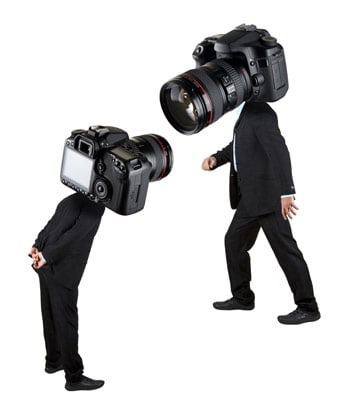
Camera manufacturers are always bickering about who is better. Canon and Nikon against Sony... cage match!
Con #4: Fewer available accessories
As I mentioned previously in the section on how proprietary Sony is, it is difficult to buy accessories for Sony cameras. If you want a battery grip for your Nikon D7000 or Canon 60D, it is simple to find one for $50 made by a third-party manufacturer on Amazon.com. If you shoot Sony, it is much more difficult. In fact, even Sony doesn’t produce battery grips for all of its cameras. Battery grips are only one example, but it can be a major headache. If you want to get into flash photography, I would strongly suggest staying away from Sony.
Con #5: Electronic Viewfinders
This is a personal preference, but I just can’t stand electronic viewfinders. I do not like that they never seem to show the highlights accurately, which is a big deal for landscape photographers especially. The new AMOLED electronic viewfinders are a significant improvement, but they still don’t compare to the traditional prism and mirror schemes in DSLRs from Canon, Nikon, or any other manufacturer.
Con #6: Unavailability of full-frame cameras
For photographers who wish to go full frame, you will find a dramatically reduced set of options. Sony is coming out with another full frame camera in 2012 if all of the rumors are true, but the options are slim now.
Subscribe to:
Posts (Atom)
Subscribe To


 Posts
All Comments
Posts
All Comments
